The Psychology of Space: How Your Office Affects Focus, Trust, and Performance

In this guide, we’ll break down how space influences the mind and behavior – from attention and decision-making to client trust and team dynamics. You’ll learn how layout choices affect focus, why noise and visual motion change the way people think, how light and color influence cognitive states, how nature supports mental recovery, and why personalization improves performance. Most importantly, you’ll see how to apply these principles when choosing or shaping a coworking space or office so it supports the work you actually need to do.
Upgrade Your Office Environment in Riyadh
If focus, trust, and performance matter to your team, your workspace should support them. Explore a coworking environment designed with quiet zones, collaborative areas, and restorative spaces that align with how people actually think and work.
Schedule a Tour at R HouseThe focus equation: attention is limited, so spaces must reduce cognitive load
Focus is not a personality trait. It is a fragile state created when your brain can stay with one task long enough to build momentum. In environmental psychology, the key limitation is simple: attention is finite. Your mind can only process so much input before performance starts to degrade – often without you noticing the moment it happens.
That is where cognitive load comes in. Cognitive load is the “mental bandwidth” your brain spends managing what’s happening around you while you try to work. In an office, it is rarely one big distraction. It is dozens of small ones:
- A conversation you can’t fully tune out because your brain is wired to decode speech
- Movement in your peripheral vision that triggers micro-alertness
- The uncertainty of not knowing if someone will tap your shoulder in the next two minutes
- Visual clutter that forces your eyes to constantly re-orient
- The effort of finding a spot that matches the task you’re doing right now
Every one of those inputs steals a fraction of attention. One fraction is manageable. Many fractions, repeated all day, create a focus deficit.
This is why “minimal distractions” remains the most reliable condition for deep work. When distractions are reduced, your brain stops spending energy on monitoring the environment and can invest that energy into problem-solving, writing, analysis, strategy, and complex execution. People don’t just work faster. They work with less internal friction, which improves accuracy and reduces the need for rework.
But the conclusion is not that every office should be silent and isolated. Isolation can backfire when work becomes monotonous or when people lose the energizing effect of social connection. The real insight is more practical: the problem is not open spaces or closed spaces. The problem is forcing one setting to serve every cognitive need. High-performing offices reduce cognitive load by offering choice – matching the environment to the task, not forcing the task to fight the environment.
Insight: Cognitive Transitions Matter More Than Desk Count
One overlooked performance factor in modern offices is the ease of cognitive transition between tasks. High-performing teams rarely stay in one thinking mode all day. They shift from analysis to collaboration, from client calls to strategic planning. If the physical space forces those transitions to happen at the same desk, mental friction increases. Offices that provide clear spatial cues – quiet zones for deep work, defined collaboration areas, and private booths for calls – reduce the psychological effort required to “switch gears.” The result is not just higher productivity, but faster recovery between tasks and more consistent decision quality across the day.
Open-plan vs. private: the real solution is optionality, not ideology
The open-plan debate tends to produce extreme opinions because people describe different experiences as if they are universal. In reality, open-plan offices can be productive and socially energizing when they’re designed intentionally – and deeply draining when they become the default setting for everything. The difference is not the absence of walls. It is whether the space gives people control over how they work throughout the day.
Open-plan benefits when used intentionally
Open environments can support the type of work that thrives on quick feedback loops and frequent alignment. When they work, they work because they lower the “activation energy” of collaboration – the effort it takes to ask a question, share context, or coordinate in real time.
Open-plan areas often perform well for:
- Informal collaboration and short problem-solving exchanges
- Quick alignment within fast-moving teams
- Social energy that keeps motivation high during long workdays
- Faster onboarding through passive learning and visibility
- Spontaneous moments where ideas move forward because people are simply near each other
When these areas are paired with clear norms and nearby alternatives for private work, they can increase momentum without sacrificing attention.
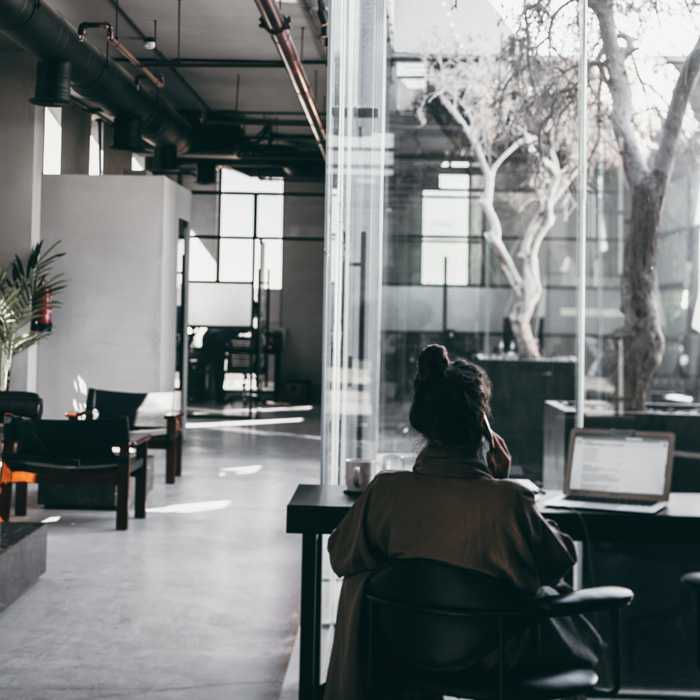
Open-plan costs when used as the default for everything
Problems appear when open-plan becomes an all-purpose container – deep work, calls, meetings, creative thinking, and sensitive conversations all forced into one acoustic and visual environment. When that happens, the office quietly trains people into shallow work: short tasks, constant checking, and frequent context switching.
The most common failure patterns include:
- Noise that interrupts concentration, even if people try to be respectful
- Visual motion that keeps the brain in a mild state of vigilance
- Interruption culture, where accessibility becomes a constant expectation
- Reduced willingness to handle sensitive conversations in the office
- A gradual shift toward reactive work, because sustained focus feels “impossible here”
The issue is not collaboration. The issue is that collaboration becomes constant and unplanned, which makes it harder for people to enter and maintain deep focus.
Private spaces aren’t “anti-culture” – they’re performance infrastructure
A well-designed private area does not damage culture. It protects the work that requires privacy, precision, and psychological safety. If your team handles strategy, finance, HR, legal, client negotiations, complex analysis, or high-stakes decisions, privacy is not a luxury. It is operational.
Private settings support:
- Deep focus work that requires long, uninterrupted thinking
- Sensitive calls and confidential conversations
- High-cognitive tasks like writing, analysis, planning, and decision-making
- Moments when someone needs calm to regain clarity under stress
- Work that demands accuracy more than speed
Importantly, private space does not have to mean permanent isolation. It can be a small room, a reservable pod, a phone booth, or a quiet zone – anything that gives the brain relief from constant monitoring.
Insight: Professional Environments Shape Risk-Taking
Workspace design subtly influences how willing people are to share ideas or take calculated risks. In environments where acoustics protect conversations and meeting rooms feel structured and private, individuals are more likely to propose bold strategies or raise sensitive issues. Conversely, when spaces lack privacy or feel chaotic, teams default to safer, surface-level contributions. In fast-growing markets such as the office environment Riyadh, where innovation and credibility must coexist, professional spatial design does more than impress clients – it creates psychological safety that directly impacts strategic thinking and long-term growth.
The modern best practice: flexible workspace design
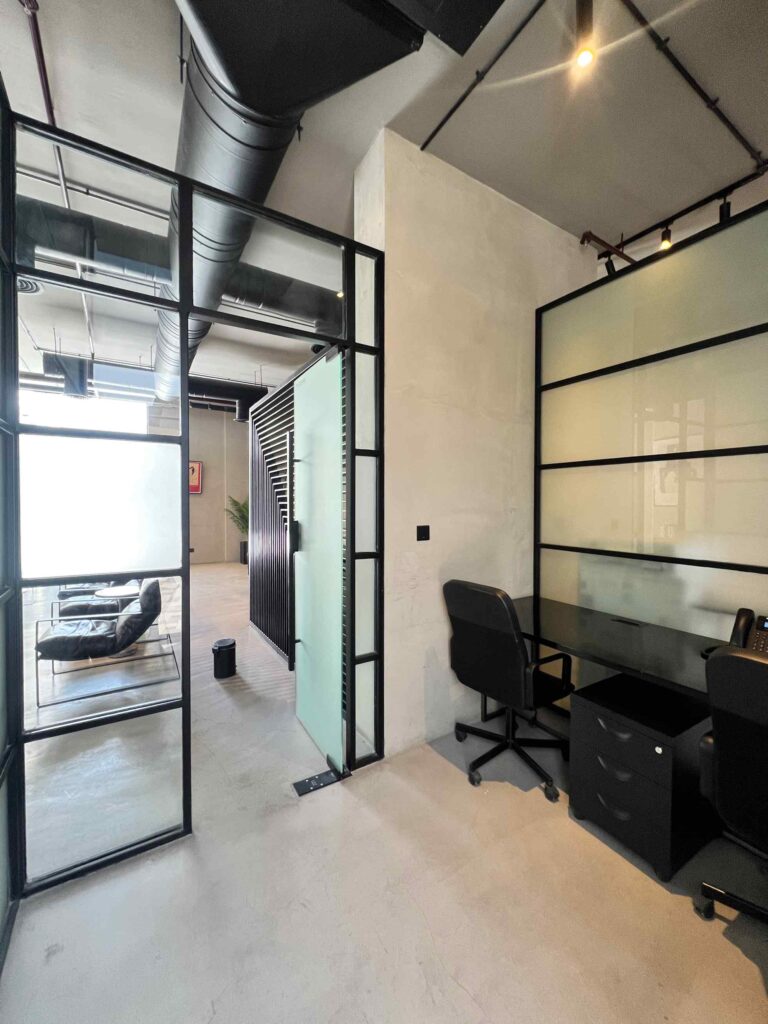
The most effective approach is not choosing a side. It is designing a menu of work settings so people can match space to task. This is the core of flexible workspace design: multiple environments within one workplace, each supporting a specific cognitive mode.
A practical “menu” usually includes:
- Quiet zones for deep work and controlled acoustics
- Collaborative areas for team projects and shared momentum
- Private pods or phone booths for calls and confidential tasks
- Meeting rooms with reliable tech for structured discussions
- Casual spaces for informal interactions and relationship-building
Design Your Workday Around How You Think
Move beyond one-size-fits-all offices. Choose between Resident private studios or flexible Nomad access and work from a space that supports deep focus, creative collaboration, and professional client meetings in Riyadh.
Explore Membership OptionsTrust and credibility: what your office silently communicates to clients and teams
Every office sends signals long before a meeting begins. The layout, reception area, lighting, and acoustics all communicate expectations about professionalism and reliability. This “signal value” shapes how clients interpret competence and how teams interpret standards.
Order and cleanliness suggest discipline. Clear zoning suggests intentionality. Acoustic privacy suggests discretion. Even the way a guest is greeted at reception contributes to perceived credibility. These environmental cues operate quickly and often subconsciously. Before anyone presents a strategy or shares numbers, the room has already influenced how seriously they are taken.
Meeting rooms play an especially powerful role in trust-building. A well-designed room with reliable conferencing technology, appropriate lighting, and comfortable seating signals preparedness. In contrast, poor audio quality, unstable internet, or awkward seating arrangements undermine authority. When technology works seamlessly, attention stays on the content rather than the environment.
Predictable guest policies also matter. When visitors know how long they can stay, where they should check in, and what to expect, uncertainty disappears. Confidence increases because the environment feels managed and professional rather than improvised.
In coworking settings, the strongest operators understand this clearly. They reduce friction by offering structured reception processes, bookable meeting rooms with clear capacity guidelines, and stable high-speed connectivity. Reliable Wi-Fi, well-equipped conference rooms, and transparent booking systems remove guesswork. For both clients and team members, that reliability reinforces trust. The office becomes a platform for credibility rather than a risk factor.
The holistic wellbeing effect: why good design cascades into better decisions and support
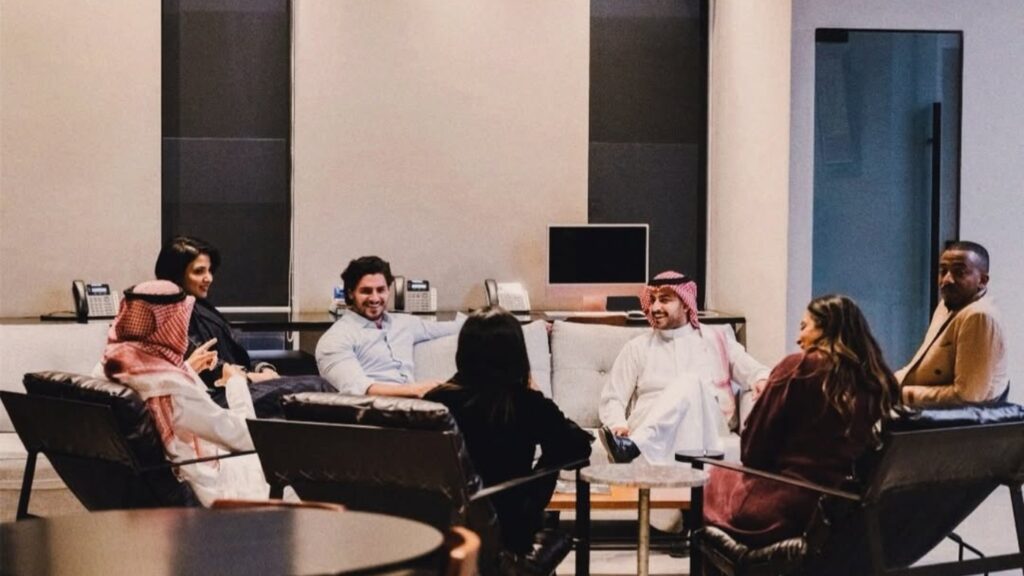
Office design influences more than productivity metrics. It shapes psychological conditions that determine how people feel about their work and about each other. Research in environmental psychology suggests that well-planned workspaces correlate with higher perceived decision authority, greater skill discretion, and stronger social support networks. In other words, the environment can reinforce whether people feel empowered and connected.
When spatial flow is organized effectively, comfort and functionality improve in measurable ways. Studies from the Environmental Psychology Institute indicate that thoughtful layout and circulation planning can significantly increase perceived comfort and enhance overall functionality. When movement between zones is intuitive and friction is reduced, daily tasks require less effort.
The cascading effects are practical:
- Fewer micro-irritations caused by noise, clutter, or unclear boundaries
- Clearer decision-making because cognitive load is reduced
- Calmer collaboration since discussions happen in appropriate settings
- Greater mutual support as social areas encourage informal connection
- Lower burnout risk because restoration and privacy are built into the design
Leaders care about outcomes: performance stability, quality of decisions, and sustainable energy across teams. Good design supports all three. It does not replace strong management or clear strategy, but it removes environmental barriers that silently erode them.
R House is a progressive coworking space in Riyadh created for innovators, creators, leaders, and entrepreneurs who value both performance and wellbeing. Designed to support focus, collaboration, and recovery within a single environment, it offers flexible solutions that adapt to different working styles and stages of growth.
Work From a Space That Builds Focus and Credibility
From private meeting rooms with conferencing technology to terraces and courtyards that support mental restoration, R House offers a professional setting where productivity and trust grow naturally.
Book Your Visit TodayFAQ – Psychology of Office Design
Does open-plan reduce productivity for focus work?
Open-plan environments can reduce productivity for deep focus tasks when they are the only available setting. Noise, visual movement, and frequent interruptions increase cognitive load and fragment attention. However, when open areas are combined with quiet zones and private spaces, productivity improves because employees can choose the environment that fits their task. The issue is not openness itself, but lack of optionality.
What design elements improve deep work the most?
Deep work benefits most from controlled acoustics, minimal visual distraction, access to natural light, ergonomic seating, and clearly defined quiet zones. Spatial separation from high-traffic collaboration areas significantly reduces cognitive load. In high-performance environments such as the office environment Riyadh, structured zoning and lighting alignment are especially important for sustained analytical work.
How does biophilic design help with stress and attention fatigue?
Biophilic design integrates natural elements such as daylight, plants, natural textures, and outdoor views into the workspace. According to Attention Restoration Theory, exposure to natural stimuli helps reset directed attention and reduce mental fatigue. Rather than serving as decoration, these elements function as cognitive recovery tools, supporting emotional balance and sustained concentration.
Which colors are best for focus versus creativity?
Cooler tones such as blue and green are associated with calm and sustained attention, making them suitable for focus-heavy zones and analytical teams. Warmer tones like yellow can stimulate optimism and creative exploration, which is helpful in brainstorming areas. Color should complement layout, lighting, and acoustics rather than replace them.
How can teams personalize space in a shared office?
Even in coworking settings, psychological ownership can be supported through personal storage, consistent desk options, adjustable ergonomic furniture, and reservable team areas. Allowing small decor elements or workspace configuration choices increases autonomy, reduces stress, and strengthens engagement without disrupting shared environments.
What should I look for in meeting rooms to increase client trust?
Professional meeting rooms should offer reliable high-speed internet, clear video conferencing technology, appropriate lighting for presentations and hybrid calls, acoustic privacy, and comfortable seating. Reception processes and guest policies should be clear and predictable. These elements signal organization, discretion, and credibility before any conversation begins.
Does office layout influence employee wellbeing long term?
Yes. Office layout influences perceived autonomy, social support, and decision authority. When environments reduce friction, offer restorative spaces, and allow movement between focus and collaboration zones, employees experience lower stress and greater engagement. Over time, this contributes to more stable performance and reduced burnout risk.